


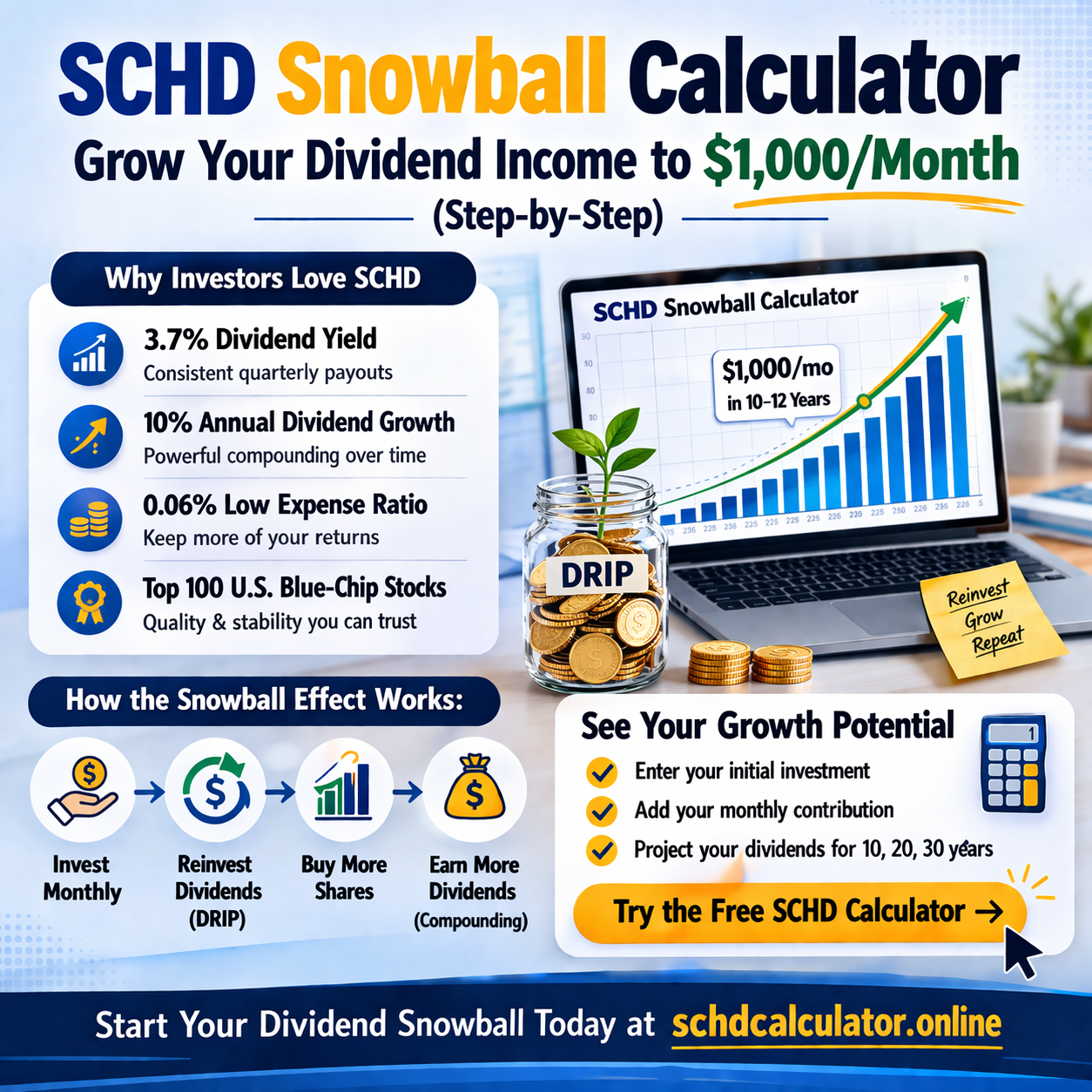
SCHD Snowball Calculator: How to Grow Your Dividend Income to $1,000/Month

What if you could turn a $10,000 investment into $1,000 per month in passive dividend income — without picking individual stocks, timing the market, or spending hours researching?
That’s exactly what thousands of investors are doing with SCHD — one of the most popular dividend ETFs in the world. And with the SCHD Snowball Calculator, you can model exactly when and how you’ll reach your own income goals.
In this guide, you’ll learn:
- What SCHD is and why investors love it
- How the dividend snowball effect works
- How to use the SCHD Snowball Calculator
- A real example showing $500/month growing over 20 years
- Tips to maximize your SCHD dividend returns
What Is SCHD? (And Why Dividend Investors Love It)
SCHD stands for the Schwab U.S. Dividend Equity ETF. It tracks the Dow Jones U.S. Dividend 100 Index — a curated list of 100 high-quality U.S. companies with strong histories of paying and growing dividends.
Key Facts About SCHD:
- Annual Dividend Yield: Approximately 3.5%–4.0% (historically)
- Dividend Growth Rate: ~10–12% per year over the past decade
- Expense Ratio: Only 0.06% — extremely low
- Holdings: Top U.S. blue-chip companies like Coca-Cola, Verizon, Home Depot
- Payout Schedule: Quarterly (March, June, September, December)
SCHD is beloved by dividend investors because it combines a solid yield with consistent dividend growth — a combination that powers the snowball effect.
What Is the SCHD Dividend Snowball Effect?
The snowball effect in dividend investing refers to the compounding power of reinvesting your dividends. Each dividend payment buys more shares. More shares pay more dividends. Those dividends buy even more shares. And so on.
It’s called a “snowball” because — just like a snowball rolling downhill — it starts small and grows exponentially over time. The longer it rolls, the bigger it gets.
A Simple Example:
- You invest $10,000 in SCHD at a 3.7% yield
- Year 1: You earn $370 in dividends
- You reinvest all $370 → now you have $10,370 invested
- Year 2: You earn dividends on $10,370 (more than before)
- Add SCHD’s ~10% annual dividend growth rate on top of that…
After 20–25 years, that original $10,000 can be generating thousands of dollars per year in passive income. That’s the snowball at work.
What Is the SCHD Snowball Calculator?
The SCHD Snowball Calculator (available at schdcalculator.online) is a free, beginner-friendly tool that lets you model your dividend growth journey. Instead of using guesswork or complicated Excel spreadsheets, it does the math for you.
What Can the Calculator Do?
- Project your total dividends earned over any time period
- Model DRIP (Dividend Reinvestment Plans) to show the snowball effect
- Adjust variables like initial investment, monthly contributions, yield, and dividend growth rate
- Compare scenarios — what happens if you add $200/month vs. $500/month?
- Visualize your portfolio growth in an easy-to-read chart
How to Use the SCHD Snowball Calculator (Step-by-Step)
Using the calculator takes less than 2 minutes. Here’s exactly how to do it:
Step 1: Enter Your Initial Investment
This is how much money you’re starting with today. You can start with as little as $100. Enter your starting amount (e.g., $5,000 or $10,000).
Step 2: Set Your Monthly Contribution
How much will you add every month? Even adding $100–$300/month makes a dramatic difference over 10–20 years. Enter your planned monthly contribution.
Step 3: Input SCHD’s Dividend Yield
SCHD’s historical yield typically falls between 3.4% and 4.2%. A safe assumption for projections is 3.7%. Use current or historical yield data for accuracy.
Step 4: Set the Annual Dividend Growth Rate
SCHD has historically grown its dividend at roughly 10–12% per year. For a conservative estimate, use 8–10%. This is what supercharges the snowball effect.
Step 5: Choose Your Time Horizon
How many years do you want to project? Try 10, 20, and 30 years to see the dramatic difference time makes. Enable the DRIP toggle to see reinvested growth.
Step 6: Analyze Your Results
The calculator shows your projected annual dividends, total portfolio value, and how much income you could earn each month at different points in your journey.
Real Example: $500/Month Into SCHD Over 20 Years
Let’s run a realistic scenario through the SCHD Snowball Calculator:
- Initial Investment: $10,000
- Monthly Contribution: $500/month
- Dividend Yield: 3.7%
- Annual Dividend Growth: 10%
- DRIP Enabled: Yes (reinvest all dividends)
- Time Horizon: 20 years
Projected Results:
- Year 5 Annual Dividends: ~$2,800/year ($233/month)
- Year 10 Annual Dividends: ~$8,500/year ($708/month)
- Year 15 Annual Dividends: ~$22,000/year ($1,833/month)
- Year 20 Annual Dividends: ~$55,000/year ($4,583/month)
That’s the power of the dividend snowball. Your money works harder than you do — and keeps accelerating the longer you stay invested.
DRIP vs. No DRIP: Does Reinvesting Dividends Really Matter?
Short answer: absolutely yes. The SCHD Snowball Calculator lets you toggle DRIP on and off to see the difference. Here’s why it matters so much:
- Without DRIP: You take your dividends as cash. Growth is linear.
- With DRIP: Dividends buy more shares. Those shares pay more dividends. Growth is exponential.
Over 20 years, DRIP can more than double your total returns compared to taking dividends as cash. The earlier you start reinvesting, the more dramatic the difference.
5 Tips to Maximize Your SCHD Dividend Snowball
- Start as early as possible. Time is the most powerful variable in the calculator. Even 2–3 extra years makes a huge difference.
- Always reinvest dividends (DRIP). Don’t touch the dividends until you reach your income goal. Let the snowball grow.
- Add monthly contributions consistently. Consistency beats timing. Even $100/month adds up dramatically over decades.
- Hold SCHD in a tax-advantaged account. Holding SCHD in a Roth IRA or 401(k) means your dividends grow tax-free, supercharging the snowball.
- Use the calculator to stay motivated. Run your numbers every 6–12 months. Watching your projected income grow keeps you on track.
Frequently Asked Questions About the SCHD Snowball Calculator
Is the SCHD Snowball Calculator free to use?
Yes. The SCHD Snowball Calculator at schdcalculator.online is completely free. No sign-up, no hidden fees, no subscription required.
How accurate are the projections?
The calculator uses realistic historical assumptions based on SCHD’s actual dividend yield and growth rate. However, past performance doesn’t guarantee future results. Use projections as a planning guide, not a guarantee.
Can I use this calculator for other dividend ETFs?
The calculator is currently optimized for SCHD. However, you can manually adjust the yield and growth rate fields to model other dividend ETFs like VYM, HDV, or DGRO.
What is a realistic dividend yield to use for SCHD?
SCHD’s yield has historically ranged between 3.0% and 4.5%. A conservative estimate of 3.5%–3.7% is a solid baseline for long-term projections.
How long does it take to reach $1,000/month in SCHD dividends?
It depends on your starting amount and monthly contributions. With $10,000 initial investment and $500/month contributions, most investors can reach $1,000/month in dividends within 10–12 years using DRIP.
Final Thoughts: Start Your Dividend Snowball Today
The SCHD Snowball Calculator isn’t just a fun tool — it’s a financial planning companion that helps you visualize the path to financial independence through dividend investing.
Whether you’re just starting out with $1,000 or scaling up a $100,000 portfolio, the calculator shows you exactly what’s possible when you combine SCHD’s reliable dividends with consistent investing and the power of compounding.
The best time to start your dividend snowball was yesterday. The second best time is today.
Try the free SCHD Snowball Calculator now at schdcalculator.online and see how close you are to your financial freedom number.
Disclaimer: This blog post is for educational and informational purposes only. It does not constitute financial advice. Always do your own research and consult a qualified financial advisor before making investment decisions. Past dividend performance does not guarantee future results.